

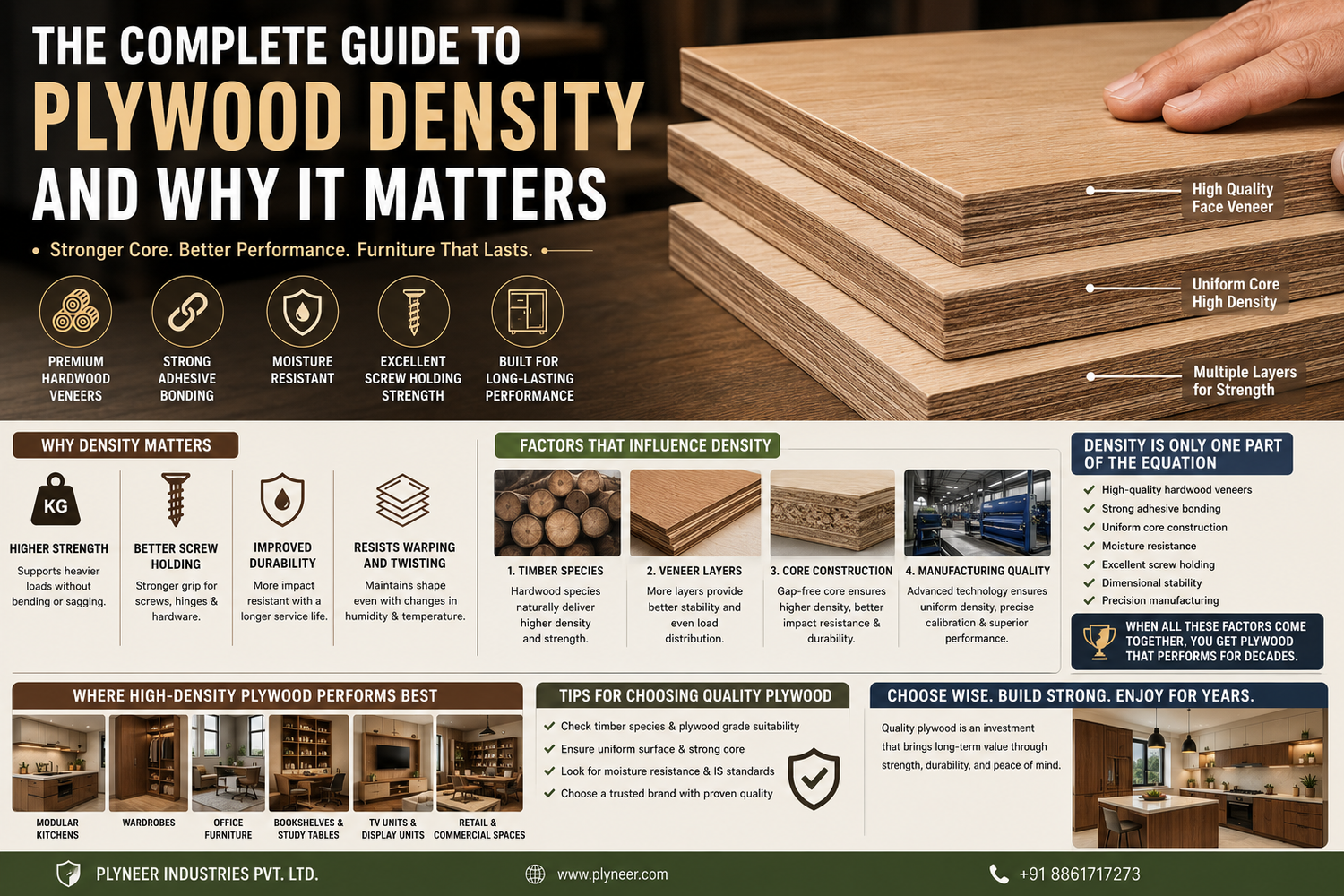
The Complete Guide to Plywood Density and Why It Matters
Walk into any plywood store, and you'll hear terms like BWP, MR, calibrated plywood, hardwood core, and Gurjan face veneer. While these are all important, there's another factor that often goes unnoticed—plywood density.
Many homeowners compare plywood based on price or warranty alone, but professionals know that density plays a major role in determining how well a plywood sheet performs over time. From the strength of a wardrobe shelf to the durability of a modular kitchen, density influences almost every aspect of furniture performance.
If you're planning to build furniture that lasts for decades, understanding plywood density will help you make a smarter and more informed decision.
What Is Plywood Density?
Plywood density refers to how much wood material is packed into a specific volume of plywood. In simple terms, it indicates how compact and solid the plywood is.
A denser plywood sheet generally contains more wood fibres and fewer internal voids, making it stronger and more stable. However, higher density alone does not guarantee better quality. The type of timber, quality of veneers, adhesive bonding, and manufacturing process all contribute to the final performance.
Think of density as one important indicator of quality—not the only one.
Why Density Matters
The density of plywood affects several critical performance characteristics that determine how well your furniture performs over time.
Strength and Load-Bearing Capacity
High-density plywood can support heavier loads without bending or sagging.
This makes it ideal for:
- Wardrobes
- Kitchen cabinets
- Bookshelves
- Office furniture
- Loft storage
- Display units
Shelves made from low-density plywood are more likely to sag when loaded with heavy objects.
Better Screw Holding Strength
Modern furniture depends on screws to secure hinges, drawer channels, handles, and other hardware.
Higher-density plywood offers:
- Better grip for screws
- Stronger joints
- Reduced loosening over time
- Improved furniture stability
This is one reason premium furniture manufacturers prefer high-quality plywood.
Improved Durability
Furniture is expected to withstand years of everyday use.
Plywood with good density generally provides:
- Better impact resistance
- Reduced edge damage
- Longer service life
- Greater structural stability
This means fewer repairs and longer-lasting furniture.
Resistance to Warping
Changes in humidity and temperature can cause poor-quality plywood to warp or twist.
Well-manufactured plywood with consistent density and balanced veneer construction offers better dimensional stability, helping cabinets and wardrobes retain their shape over time.
Does Heavier Always Mean Better?
One of the biggest misconceptions is that the heaviest plywood is always the best.
This isn't entirely true.
A plywood sheet may be heavier because:
- It uses dense hardwood veneers.
- It contains excess moisture.
- Lower-quality timber has been used.
- The adhesive content is unusually high.
Similarly, an extremely light sheet may indicate fewer veneers, lower-density timber, or internal voids.
The ideal plywood strikes a balance between weight, structural strength, and manufacturing quality.
Factors That Influence Plywood Density
Several factors determine the density of a plywood sheet.
1. Timber Species
Hardwood species naturally produce denser and stronger plywood than softwoods.
Premium hardwood veneers generally offer:
- Better strength
- Improved durability
- Superior screw holding
- Longer lifespan
2. Number of Veneer Layers
More veneer layers usually improve structural stability.
A well-balanced construction distributes stress evenly and increases the strength of the panel.
3. Core Construction
The internal core should be free from large gaps and weak joints.
A high-quality core provides:
- Better load distribution
- Higher impact resistance
- Greater durability
4. Manufacturing Quality
Advanced manufacturing techniques ensure:
- Uniform density
- Consistent thickness
- Proper adhesive bonding
- Precision calibration
Quality manufacturing often has a greater impact on performance than density alone.
Typical Density Range of Plywood
While density varies depending on timber species and manufacturing methods, premium hardwood plywood generally falls within a higher density range than economy plywood.
Rather than focusing only on numerical density values, buyers should evaluate:
- Consistent construction
- Strong core
- Smooth finish
- Moisture resistance
- Reliable certifications
- Manufacturer reputation
These characteristics provide a more complete picture of quality.
Where High-Density Plywood Performs Best
Premium plywood is recommended for applications where strength and durability are essential.
These include:
- Modular kitchens
- Wardrobes
- Office furniture
- Study tables
- Bookshelves
- TV units
- Hotel furniture
- Commercial interiors
- Retail fixtures
- Educational institutions
These applications benefit from improved load-bearing capacity and longer service life.
Density Is Only One Part of the Equation
When buying plywood, don't judge quality based on weight alone.
A premium plywood sheet combines:
- High-quality hardwood veneers
- Strong adhesive bonding
- Uniform core construction
- Moisture resistance
- Excellent screw holding
- Dimensional stability
- Precision manufacturing
Together, these factors create plywood that performs reliably for decades.
Tips for Choosing Quality Plywood
Before purchasing plywood, consider the following:
✔ Ask about the timber species used.
✔ Check whether the plywood is suitable for your application.
✔ Look for a uniform, well-finished surface.
✔ Ensure the sheet is free from visible gaps or defects.
✔ Verify the applicable IS standards.
✔ Choose a trusted manufacturer with proven quality.
Remember, the cheapest plywood often becomes the most expensive when repairs and replacements are needed.
Conclusion
Plywood density plays an important role in determining the strength, durability, and long-term performance of your furniture. While higher density generally contributes to better load-bearing capacity and screw holding strength, it should always be considered alongside manufacturing quality, timber species, core construction, and adhesive bonding.
Whether you're building a modular kitchen, wardrobes, office furniture, or commercial interiors, investing in well-manufactured premium plywood ensures your furniture remains strong, stable, and reliable for many years.
Instead of comparing plywood by price alone, evaluate the factors that truly affect performance. A quality plywood sheet is an investment that delivers lasting value through reduced maintenance, greater durability, and peace of mind.
Why Choose Plyneer?
At Plyneer Industries Pvt. Ltd., we manufacture premium plywood using carefully selected hardwood veneers, precision manufacturing techniques, and strict quality control processes. Our plywood is engineered to deliver excellent screw-holding strength, dimensional stability, moisture resistance, and long-lasting performance for homes, offices, and commercial projects.
Whether you're a homeowner, architect, interior designer, builder, or furniture manufacturer, Plyneer provides dependable plywood solutions designed to meet the demands of modern construction and furniture manufacturing.
Build stronger. Build smarter. Built with Plyneer.
📞 +91 8861717273


