

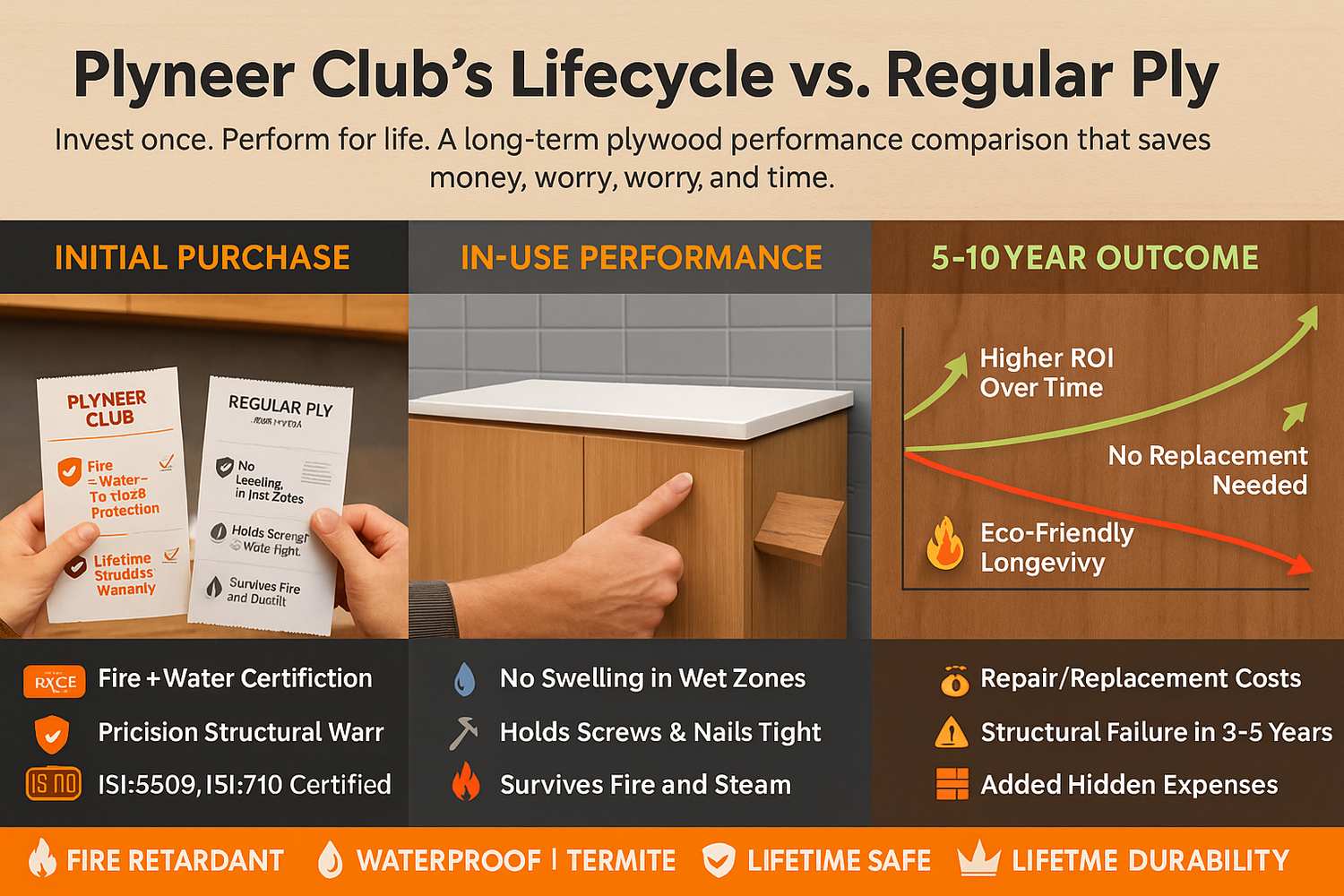
What We Mean by “Lifecycle”
By “lifecycle” we refer to how long the plywood product will:
-
Remain structurally and aesthetically sound
-
Resist damage from water, humidity, insects, fire
-
Retain its glue bonds, shape, finish without warping or delamination
-
Need less maintenance, repair, or replacement
A good plywood should endure home conditions (monsoons, cooking steam, wear & tear) for many years before major problems arise.
Regular Plywood: Typical Lifecycle & Weaknesses
Regular or lower‑graded plywood (non‑marine, non‑fire retardant) often has the following features and limitations:
| Feature | Typical Performance | Weaknesses / Failure Modes |
|---|---|---|
| Core & Glue | Often made with soft or mixed woods; adhesives like urea formaldehyde or weaker resins | Glue may degrade in high humidity; core may swell; delamination risks |
| Resistance to Water / Moisture | Tolerates occasional damp but poorly resists constant moisture or steam | Surface warping, bubbling laminates/veneers, peeling edges |
| Fire Safety | Usually none or minimal fire retardant treatment | Risk of flame spread, higher smoke, safety hazard |
| Insect / Fungal Resistance | Low to moderate, depending on treatment | Termite/borer damage, mold growth in damp zones |
| Aesthetic Lifespan | Colors/laminates fade, surfaces degrade over years | Discoloration, dents, peeling finish |
| Maintenance & Repair Needs | Frequent repairs, replacement of warped parts, higher lifecycle cost | Let’s say 5‑10 years in moisture‑prone areas; perhaps more in dry interiors |
Typical lifespan for regular plywood in good indoor, dry conditions might be 8‑15 years, but under harsh usage (kitchen, bathroom, coastal environment) serious issues often show up within 2‑5 years.
Cited from sources:
- Marine grade plywood lasts 15‑25 years with good finishes; regular plywood degrades much earlier.
- In fully exposed environments, regular plywood often shows degradation within 2‑3 years if not treated.
Plyneer Club: Expected Lifecycle & Advantages
Plyneer Club is positioned (from your earlier messages) as high‑performance: fire retardant, waterproof, ISI‑certified, lifetime warranty, etc. Based on that and general engineering principles, here’s how its lifecycle compares.
| Feature | How Plyneer Club Excels | Expected Benefits & Longer Life |
|---|---|---|
| Waterproofing | Uses high‑grade resin adhesion (boiling‑proof grade), avoids core voids; designed to resist steam, kitchen & bathroom humidity | Maintains shape, resists swelling, avoids delamination; stays usable in wet zones much longer (10‑20+ years) |
| Fire Retardant Treatment | Built‑in fire retardant chemicals & certifications (for example IS:5509, if true) | Reduces risk of damage from heat/fire; safety upheld in more scenarios; less fire‑related wear and damage |
| Termite / Fungus Resistance | Treated core / wood + protective resins / treatment | Less decay, fewer insect damages; longer durable joints & fasteners |
| Surface Finish Compatibility and Smooth Core | Calibrated and smooth core means better adhesion of finishes; less peeling or edge failure | Looks good for longer; fewer aesthetic degradations; less frequent need for refinishing or patchups |
| Structural Integrity under Stress (Wear & Tear) | Strong core, quality veneers, good glue → stronger screw/nail holding; better load capacity | Cabinets, shelves, panels will last longer without sagging or failure |
Factors that Influence Lifecycle (Even for Plyneer Club)
Even high‑performance plywood like Plyneer Club will have its lifespan influenced by:
- Installation quality (sealing edges, proper fixing, avoiding water traps)
- Maintenance (cleaning, avoiding prolonged exposure to water, treating surface damage early)
- Finish protection (laminates, PU, proper coatings)
- Environment (coastal vs dry inland, monsoon exposure, humidity)
- Usage intensity (heavy load, frequent wet usage, mechanical stress)
Key Takeaway
-
If you compare upfront cost vs lifecycle cost, Higher‑grade plywood (like Plyneer Club) tends to offer much better return on investment due to fewer repairs, longer performance, better safety, and less frequent replacement.
-
For critical zones (kitchen, bath, outdoor exposure, high humidity, high fire risk), moving from regular plywood to something like Plyneer Club not only improves peace of mind but brings down total lifetime costs.


