

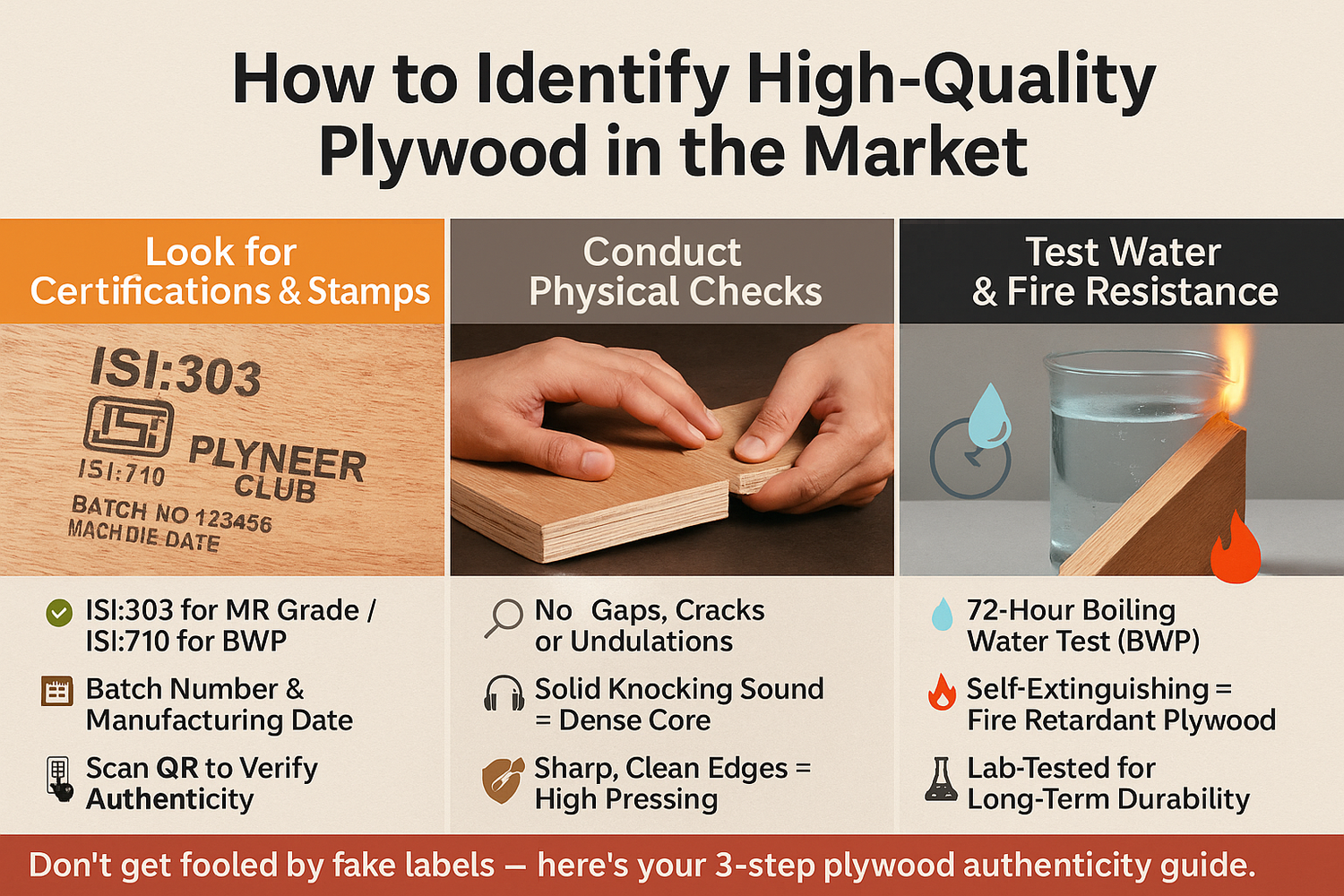
1. Check the ISI Mark and Grade
The most reliable indicator of quality is a valid ISI mark, especially:
- ISI:710 – Denotes Boiling Water Proof grade, suitable for kitchens, bathrooms, and wet areas.
- ISI:303 – Used for Moisture Resistant (MR) plywood, only suitable for dry areas.
✅ Tip: Look for a printed ISI mark along with the license number on the sheet's edge or surface. Counterfeits often use fake stamps, so verify with the brand or manufacturer website.
2. Inspect the Core and Layers (Plies)
High-quality plywood is made from multiple layers of uniform hardwood veneers, bonded with care and minimal gaps. Here’s what to check:
| Quality Indicator | Good Plywood | Poor-Quality Plywood |
|---|---|---|
| Core Gaps/Voids | Minimal or none | Visible hollow sections |
| Uniform Thickness | Even all over | Warped or wavy surface |
| Core Material | Hardwood like Eucalyptus | Poplar or soft filler |
✅Tip: Look at the plywood edge — if you see inconsistent layers or lots of voids, avoid it.
3. Water and Fire Resistance Test
For waterproof plywood, such as Plyneer Club, check these:
- Boiling Water Test: A high-grade waterproof ply should not delaminate or warp after 72 hours in boiling water.
- Fire Retardant Properties: Premium fire-safe ply is treated with chemicals that slow ignition and flame spread (check for certifications like IS:5509 or equivalent).
✅ Tip: Ask your dealer to show you a fire test demo or waterproof sample test. Brands like Plyneer conduct real-life experiments to prove performance.
4. Press Your Thumb (The Nail Test)
Push your fingernail into the surface:
- If it leaves a deep impression easily, it’s likely soft-core or low-density ply.
- High-quality ply (like Plyneer Club) resists surface dents due to higher density and calibrated layers.
5. Smell and Touch Test
- A strong chemical smell may mean excessive urea-formaldehyde resin (harmful).
- Plyneer Club, being eco-safe, uses low-emission glue with minimal VOCs — better for indoor air quality.
✅ Tip: Smell the sheet. Safe plywood shouldn't have a sharp, irritating odor.
6. Look for Calibration and Smooth Finish
Premium-grade plywood (like calibrated Plyneer Club) has:
- Perfectly even thickness (±0.03mm variance)
- Smooth face veneer with no sanding needed
- Ideal for laminates, veneers, or polish finish
✅ Tip: Run your hand over the surface. It should feel smooth, consistent, and free from bubbles or waves.
7. Ask for Termite & Borer Resistance Proof
In India, termite damage is a serious threat, especially in monsoon-prone areas. Good plywood will have:
- Chemical treatment with boric/borax compounds
- Anti-borer barrier layers
- Test reports or warranty against termite damage
✅ Tip: Plyneer Club comes with TermiBlock+ protection and often includes long-term guarantees.
8. Warranty, Certification, and Brand Assurance
Reliable plywood brands offer:
- Long-term warranties (15–30+ years)
- ISI/ISO/FSC/CE certifications
- Transparent customer service
✅ Tip: Always buy from reputed manufacturers. Plyneer Club, for example, offers lifetime warranty and batch-traceable sheets — a sign of accountability and premium quality.
Common Red Flags
❌ Plywood feels very light (indicates soft-core).
❌ Wavy, undulating surface.
❌ Uneven smell or strong chemical odor.
❌ Easily dented or cracked edge.
❌ No markings or fake ISI stamp.
Final Thoughts
Buying plywood blindly can lead to long-term regret — from swelling, warping, termite attacks, or fire hazards. By following this checklist, you can confidently choose high-performance plywood for every space in your home or project.
If you want zero compromises on waterproofing, fire safety, termite resistance, and strength, Plyneer Club is engineered to give you all that — and more — backed by real tests and customer trust.


