

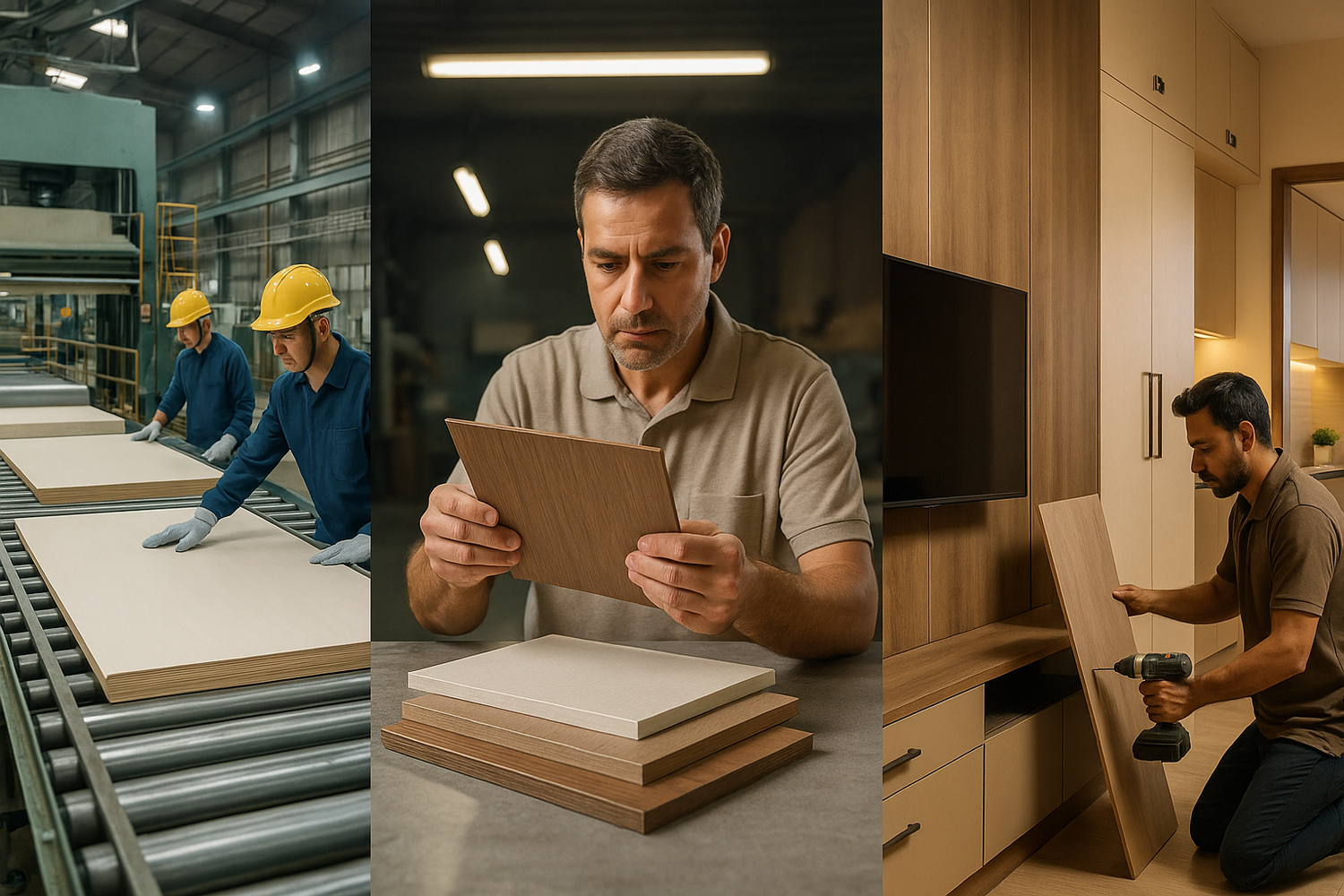
When a laminate finally becomes part of a beautiful wardrobe, kitchen, or TV unit, very few people think about the journey it has taken.
At Plyneer, every laminate goes through a carefully controlled process—from raw material selection to high-pressure manufacturing and final quality checks—before it reaches your home.
This is the story of how Plyneer Laminates are made, and why that process matters for durability, finish, and long-term performance.
1. Step One: Selecting the Right Raw Materials
Quality begins at the source.
✔ What Plyneer Focuses On
- High-grade decorative papers for colour accuracy
- Dense kraft paper layers for strength
- Premium melamine resins for surface protection
Only materials that meet Plyneer’s internal standards move to the next stage.
2. Step Two: Layering for Strength & Stability
A laminate is not a single sheet—it’s a layered structure.
✔ The Core Structure
- Multiple layers of kraft paper form the backbone
- Decorative paper adds design and colour
- A protective overlay improves scratch & stain resistance
These layers are precisely aligned to ensure uniform thickness and surface consistency.
3. Step Three: High-Pressure Lamination Process
This is where the laminate gets its real strength.
✔ What Happens Here
- Layers are pressed under high pressure and high temperature
- Resins fuse the layers into a single, solid sheet
- Surface becomes hard, durable, and moisture-resistant
This process ensures Plyneer laminates can withstand daily wear, heat, and cleaning.
4. Step Four: Surface Finishing & Texturing
Design is not just visual—it’s tactile.
✔ Finishing Options
- Matte finishes for modern, fingerprint-resistant surfaces
- High-gloss finishes for premium, reflective looks
- Textured finishes like woodgrain, fabric, stone & concrete
Advanced press plates create realistic textures that feel natural and refined.
5. Step Five: Precision Cutting & Sizing
Once pressed, laminates are trimmed to exact dimensions.
✔ Why This Matters
- Clean edges for easy application
- Consistent sizing for modular furniture
- Reduced wastage during installation
Precision ensures smooth execution at the carpenter’s workshop.
6. Step Six: Quality Control at Every Stage
Before any laminate leaves the factory, it is tested.
✔ Key Quality Checks
- Surface finish inspection
- Thickness consistency
- Scratch & abrasion resistance
- Moisture resistance
- Bond strength & durability
Only laminates that pass strict quality benchmarks are approved for dispatch.
7. Step Seven: Packaging, Storage & Dispatch
Protection continues even after manufacturing.
✔ Plyneer’s Handling Standards
- Protective packaging to avoid surface damage
- Climate-conscious storage practices
- Organized warehousing for quick dispatch
- This ensures laminates reach dealers, designers, and homeowners in perfect condition.
8. From Warehouse to Furniture
Once installed, Plyneer laminates become:
- Kitchen cabinets
- Wardrobes
- TV units
- Office furniture
- Retail interiors
Because the manufacturing process is tightly controlled, the laminate performs reliably—on site and over time.
⭐ Why This Process Matters to Homeowners & Designers
A strong manufacturing process ensures:
- Long-lasting colour consistency
- Reduced chances of peeling or bubbling
- Better resistance to moisture & heat
- Cleaner finishes and easier maintenance
- Confidence that furniture will age gracefully
This is why Plyneer laminates are trusted in both budget-friendly homes and premium interiors.
⭐ Conclusion
From factory floor to finished furniture, Plyneer laminates are engineered with precision, care, and purpose. Every step—from material selection to final inspection—is designed to ensure performance you can see and durability you can trust.
When you choose Plyneer, you’re not just choosing a laminate—you’re choosing a process built on quality.


