

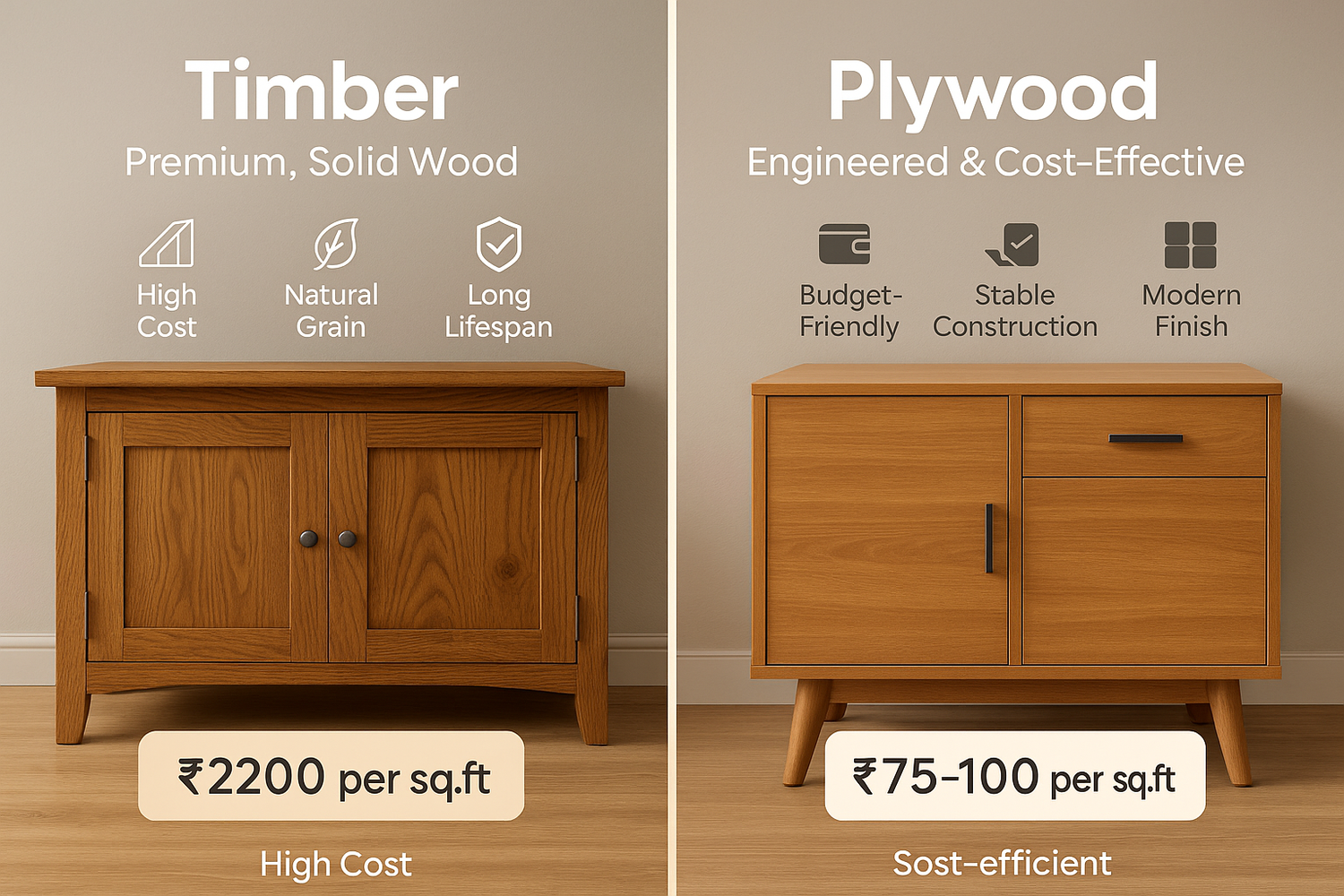
When building furniture or interiors, one of the most common debates is:
Should I use timber wood or plywood?
While timber wood (solid wood) is often associated with strength and legacy, plywood brings versatility, affordability, and convenience — especially in today’s modular setups.
This blog explores the key differences between timber and plywood, especially focusing on cost, and helps you choose what’s best for your home or project.
What Is Timber Wood?
Timber refers to solid natural wood obtained from trees like teak, sal, sheesham, pine, or neem. It is cut, seasoned, and used in furniture, doors, windows, and frames.
Advantages:
- Naturally strong and durable
- Beautiful grain texture
- Long lifespan when maintained
Limitations:
- Expensive
- Prone to expansion, warping, and cracking
- Requires termite and moisture treatment
- Less uniform in shape and size
What Is Plywood?
Plywood is a man-made board created by bonding multiple layers of wood veneers under pressure with resins. Grades include MR (IS:303), BWR, BWP (IS:710), and Marine Plywood.
Advantages:
- Affordable and widely available
- Uniform thickness and strength
- Resistant to warping and shrinking
- Can be moisture-proof and termite-resistant
- Easy to laminate, paint, or finish
Limitations:
- Edges need sealing
- Can delaminate if poor quality
- Not as strong as solid teak for structural loads
Price Comparison – Timber vs. Plywood (India 2025)
| Material Type | Avg Price (Per sq. ft) | Remarks |
|---|---|---|
| Teak Wood (Timber) | ₹250 – ₹500+ | Expensive, high maintenance |
| Sheesham Wood | ₹200 – ₹350 | Strong, heavy |
| Pine Wood | ₹100 – ₹180 | Softer, needs polish |
| Neem Timber | ₹80 – ₹150 | Durable, rustic |
| Plyneer MR Plywood (18mm) | ₹60 – ₹80 | Best for dry areas |
| Plyneer BWR Plywood | ₹80 – ₹120 | Water-resistant |
| Plyneer BWP/Marine Ply | ₹120 – ₹160 | 100% waterproof |
| Plyneer HDiHMR Board | ₹110 – ₹150 | Smooth, CNC/PU ready |
Application-Based Recommendation
| Use Case | Timber Wood | Plywood (Recommended) |
|---|---|---|
| Structural Frames | ✔️ Best Choice | 🚫 Not Ideal |
| Modular Furniture | 🚫 Too Rigid/Costly | ✔️ Cost-effective & flexible |
| Kitchen Cabinets | 🚫 Expands in moisture | ✔️ BWP or HDiHMR Ideal |
| Wardrobes & Cupboards | 🚫 Heavy, costly | ✔️ MR/BWR Plywood |
| Bookshelves | 🚫 Can warp | ✔️ 18mm Plywood |
| Bed Platform | 🚫 Overpriced | ✔️ Plyneer BWR/BWP |
| Painted Furniture | 🚫 Requires prep | ✔️ HDiHMR Board |
Why Plywood Is More Affordable
-
Engineered Efficiency
Plywood is made from thin veneers — making the best use of wood with less waste. -
Less Finishing Needed
Plywood takes laminate, veneer, and paint easily — reducing polishing costs. -
Low Transport & Labour Cost
Lightweight and ready-to-use boards save time and money. -
Bulk Manufacturing
Industrial production makes plywood cheaper and scalable compared to hand-cut timber.
Durability & Maintenance
| Feature | Timber Wood | Plywood |
|---|---|---|
| Termite Resistance | ❌ Needs Treatment | ✔️ With treated core |
| Water Resistance | ❌ Susceptible | ✔️ BWR/BWP is waterproof |
| Shape Stability | ❌ May Warp/Crack | ✔️ Highly stable |
| Finishing | ✅ Beautiful Grain | ✔️ Smooth for laminate/PU |
Plyneer Recommendation
Choose timber wood if:
- You need traditional carved furniture
- Budget is not a concern
- You prefer natural grain texture
Choose Plyneer plywood if:
- You want affordability with durability
- You’re designing modular or modern furniture
- You want moisture or termite resistance built in
Popular Plyneer Picks:
- Plyneer BWP 18mm Plywood – For bathrooms, kitchens, and beds
- Plyneer MR Grade 18mm – Budget wardrobes and shelves
- Plyneer HDiHMR Board 16mm – Designer wall panels and TV units
- Plyneer Neem BWR Plywood – Moisture-safe furniture in humid zones
Conclusion
While timber wood has heritage and charm, plywood wins in affordability, performance, and modern-day practicality. Especially for Indian homes battling humidity, termites, and evolving space needs, plywood is the smarter, more scalable choice.


