

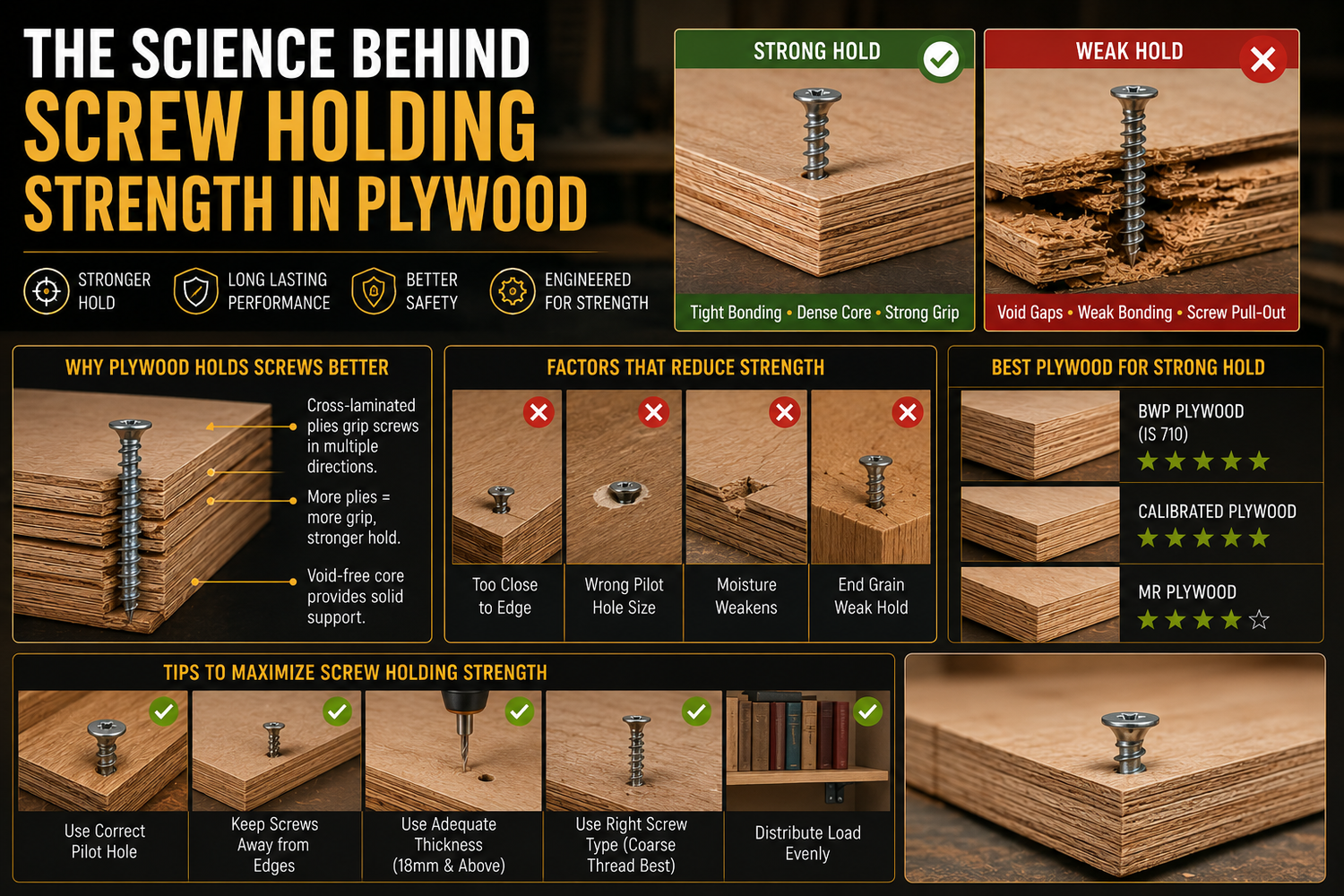
The Science Behind Screw Holding Strength in Plywood
Anyone who has fitted a cabinet hinge, mounted a wall bracket, or assembled furniture has run into this problem at some point: a screw that goes in smoothly but doesn't hold, spinning loose the moment real weight is applied. This isn't bad luck — it's physics. Screw holding strength in plywood is governed by measurable factors: the number and density of veneer layers, the quality of adhesive bonding, the direction of the grain, and the thickness of the panel at the point of entry.
Understanding the science behind screw holding strength in plywood helps homeowners, carpenters, and architects specify the right material the first time — instead of discovering a weak panel only after a shelf bracket pulls free or a cabinet hinge fails.
What Is Screw Holding Strength, and Why Does It Matter?
Screw holding strength refers to the amount of force required to pull a screw straight out of a material, or the torque required to strip its threads free of the surrounding wood fibres. In construction and furniture-making, this property matters more than most people realise — it determines whether:
- Cabinet hinges stay attached under repeated opening and closing
- Wall-mounted shelves and brackets hold their rated load
- Furniture joints stay tight over years of use
- Modular kitchen fittings resist loosening from vibration and daily handling
Unlike solid wood, plywood's screw-holding performance isn't just about species or hardness — it's a product of how the panel is engineered.
The Layered Science: Why Plywood Holds Screws Differently Than Solid Wood
Plywood is made by bonding thin wood veneers together with the grain of each layer running perpendicular to the one beneath it — a construction method called cross-lamination. This is the foundation of plywood's strength, and it directly affects how well it grips a screw.
1. Cross-Lamination Distributes Load Across Multiple Grain Directions
In solid wood, a screw driven parallel to the grain has far less holding power than one driven across it, because wood tends to split along the grain. Plywood avoids this weakness almost entirely. Since each veneer layer runs at 90 degrees to its neighbour, a screw threading through multiple layers engages wood fibres running in several directions at once. This is why quality plywood consistently outperforms solid wood panels of similar thickness when it comes to resisting screw pull-out.
2. Number of Plies Directly Affects Holding Power
More veneer layers generally means more grip. A 19mm panel built from 13 to 15 thin plies holds screws significantly better than a 19mm panel built from just 5 to 7 thicker plies, because the screw threads engage more individual bonded layers and more glue lines along their length. This is one reason calibrated plywood with consistent, tightly packed plies is preferred for cabinetry and load-bearing furniture joints.
3. Core Density and Void-Free Construction
Cheaper plywood often contains internal voids, gaps, or uneven core layers — especially in the centre of the panel. When a screw hits a void instead of solid wood fibre, it loses grip entirely at that point, and the surrounding layers alone can't compensate. Void-free, high-density plywood — built under standards like IS 303 for general-purpose use — ensures the screw has continuous, solid material to bite into along its full length.
4. Adhesive Bond Quality
The glue bonding the veneers together plays a bigger role in screw holding than most people expect. If the bond between layers is weak, the wood can delaminate — separate along glue lines — under the stress of a screw being driven or loaded, effectively reducing the panel to a single thin layer at that point. BWP (Boiling Water Proof) plywood, manufactured to IS 710, uses phenol-formaldehyde adhesives that create a bond stronger than the wood fibres themselves, which is why BWP-grade panels are commonly specified for load-bearing furniture and fittings exposed to repeated stress.
Factors That Reduce Screw Holding Strength
Even good plywood can lose holding power if these factors aren't managed correctly:
- Screwing too close to the panel edge — edges have fewer surrounding fibres to resist splitting or pull-out
- Oversized pilot holes — too large a pilot hole reduces thread engagement with surrounding wood
- No pilot hole at all — driving a screw directly into plywood without a pilot hole can crack veneer layers, especially near edges
- Repeated removal and reinsertion — each cycle enlarges the hole slightly, gradually reducing grip
- Moisture exposure — swelling and shrinking cycles from humidity can loosen the bond between screw threads and surrounding wood fibres
- Screwing into end grain or panel edges rather than the face — face screwing generally provides stronger, more consistent holding power
How to Maximise Screw Holding Strength in Plywood
1. Choose Adequate Thickness
Thicker panels give screws more material to engage. For cabinet hinges, brackets, and structural fittings, 18mm–19mm plywood is generally the minimum recommended thickness; thinner panels are better reserved for backs, panelling, or light decorative use.
2. Drill a Correctly Sized Pilot Hole
A pilot hole slightly smaller than the screw's shank allows the threads to bite into surrounding fibres without splitting the veneer layers. This single habit prevents most edge-splitting failures.
3. Position Screws Away from Edges
Keep screws at least 15–20mm from any panel edge wherever possible. Edge fixings are the most common failure point for screw pull-out.
4. Use the Right Grade for the Application
For high-stress fittings — cabinet hinges, drawer slides, wall-mounted units — specify BWP or calibrated plywood rather than economy-grade panels. The additional cost is minor compared to the cost of a failed fitting later.
5. Consider Screw Type
Coarse-threaded wood screws generally hold better in plywood than fine-threaded screws designed for metal or MDF, as the wider thread pitch engages more wood fibre per rotation.
Comparison: Plywood Types and Screw Holding Performance
| Plywood Type | Ply Count | Core Construction | Screw Holding Performance | Best Use Case |
|---|---|---|---|---|
| Economy/Commercial Plywood | Low (5–7 plies) | Often contains voids | Moderate to weak | Non-structural, budget applications |
| MR Plywood | Medium (9–11 plies) | Generally solid, moisture-sensitive bonding | Good | Dry interior furniture, wardrobes |
| BWP Plywood (IS 710) | Medium-high (11–13 plies) | Void-free, phenolic bonding | Very good | Kitchen cabinets, high-use fittings |
| Calibrated Plywood | High (13–15 plies) | Precision-pressed, uniform thickness | Excellent | Cabinetry, hinges, load-bearing joints |
| Marine Plywood | High | Void-free, maximum moisture resistance | Excellent | Exterior fittings, boats, extreme exposure |
Key Takeaways
- Screw holding strength in plywood comes from cross-lamination, ply count, core density, and adhesive bond quality — not just overall thickness.
- More, thinner plies generally outperform fewer, thicker plies at the same total thickness.
- Void-free BWP or calibrated plywood, such as Plyneer Gold BWP or Plyneer X BWP, provides significantly better screw retention than economy-grade panels.
- Pilot holes, correct screw placement away from edges, and appropriate screw type all meaningfully affect real-world holding performance.
- Moisture exposure weakens screw grip over time, making moisture-resistant grades essential for kitchens, bathrooms, and humid climates.
Conclusion
The science behind screw holding strength in plywood comes down to how the panel is engineered — the number of veneer layers, how tightly they're bonded, how dense and void-free the core is, and how the grain of each layer interacts with the one below it. A screw driven into high-grade, void-free plywood engages solid wood fibre running in multiple directions, while the same screw in a low-grade panel may hit an internal void and fail to hold at all. For cabinets, hinges, brackets, and any fitting that needs to hold firm over years of use, specifying the right plywood grade — combined with correct pilot holes and screw placement — is the most reliable way to get lasting screw holding strength in plywood.
Contact Plyneer Industries
Looking for premium-quality plywood and interior materials for your project?
At Plyneer Industries Pvt. Ltd., we provide high-performance plywood, laminates, veneers, MDF, HDHMR boards, and fire-retardant solutions designed for Indian homes, commercial spaces, and institutional projects.
Our Product Range
- Fire-Retardant Plywood
- Waterproof BWP Plywood
- Marine Grade Plywood
- Premium MR Plywood
- Decorative Laminates
- Natural Veneers
- MDF & HDHMR Boards
- Modular Kitchen Solutions
- Wardrobe & Furniture Materials
Website: https://www.plyneer.com
Call/WhatsApp: +91 8861717273
Our experts help homeowners, architects, interior designers, contractors, builders, schools, hospitals, restaurants, retail stores, and commercial projects choose the right materials for long-lasting performance, safety, and value.


