

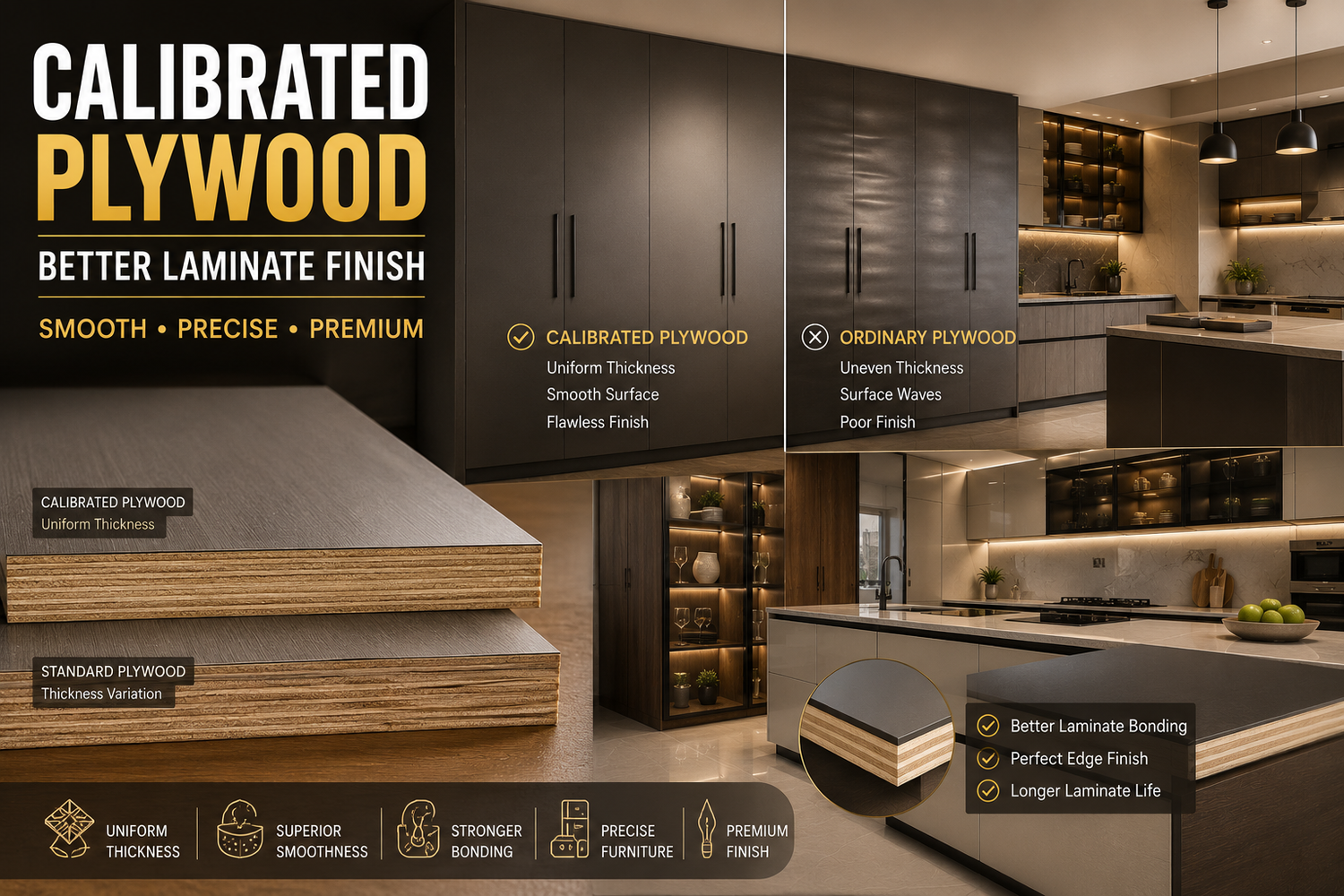
When homeowners select laminates for wardrobes, modular kitchens, TV units, office furniture, or decorative interiors, most of their attention goes toward choosing the perfect color, texture, or finish. However, even the most premium laminate cannot achieve its full potential if the plywood beneath it is uneven or inconsistent.
Many furniture-related issues such as visible surface waves, laminate bubbling, poor edge alignment, and imperfect finishes often originate from the plywood substrate rather than the laminate itself.
This is where calibrated plywood makes a significant difference.
Calibrated plywood is specially manufactured to maintain uniform thickness throughout the sheet, creating a smooth and consistent surface for laminates. This results in better bonding, enhanced appearance, improved furniture precision, and superior long-term performance.
If you're planning a modular kitchen, wardrobe, office workstation, or luxury interior, understanding how calibrated plywood improves laminate finish can help you make better material choices.
What Is Calibrated Plywood?
Calibrated plywood is plywood that undergoes a precision sanding process after manufacturing.
Unlike conventional plywood, calibrated plywood is machine-sanded on both sides to achieve uniform thickness across the entire sheet.
This process ensures:
- Consistent thickness
- Better flatness
- Smooth surface finish
- Improved dimensional accuracy
- Enhanced laminate bonding
The result is a premium plywood sheet specifically designed for modern furniture manufacturing and modular interiors.
For a better understanding of different plywood types, you can explore the complete guide available on Plyneer Industries Blog.
Why the Plywood Surface Matters for Laminates
A laminate acts like a decorative skin that reflects the quality of the surface beneath it.
If the plywood contains:
- Thickness variations
- Surface depressions
- Core gaps
- Uneven sanding
these imperfections can become visible even after lamination.
Common problems include:
Surface Unevenness
Large wardrobe shutters and kitchen panels may appear wavy under lighting.
Laminate Bubbling
Poor contact between laminate and plywood can lead to bubbles over time.
Edge Misalignment
Cabinet doors and shutters may not align properly.
Reduced Furniture Precision
Inconsistent thickness affects overall furniture quality.
Choosing calibrated plywood significantly reduces these issues.
Uniform Thickness Creates a Flawless Finish
One of the biggest advantages of calibrated plywood is its consistent thickness.
Conventional Plywood
Standard plywood often has minor thickness variations across the sheet.
Even a variation of 0.5 mm can affect furniture assembly and finishing quality.
Calibrated Plywood
Calibrated plywood maintains uniform thickness throughout the sheet.
Benefits
✔ Better panel alignment
✔ Improved furniture accuracy
✔ Smooth laminate appearance
✔ Cleaner edge finishing
For modern modular furniture, precision is critical, making calibrated plywood the preferred choice.
Better Laminate Bonding
The strength of laminate adhesion depends on how effectively the adhesive bonds with the plywood surface.
A smooth and consistent substrate creates a larger contact area between:
- Plywood
- Adhesive
- Laminate
This results in stronger bonding.
Advantages
✔ Reduced risk of delamination
✔ Better long-term performance
✔ Improved laminate durability
✔ Enhanced furniture lifespan
Poor-quality plywood often creates uneven pressure points that weaken adhesive performance over time.
Smoother Surface Means Better Aesthetics
Modern laminate designs often feature:
- High-gloss finishes
- Matte surfaces
- Metallic effects
- Solid colors
- Decorative textures
These finishes tend to reveal even minor imperfections beneath the surface.
Because calibrated plywood offers superior smoothness, the laminate appears:
- Flatter
- Cleaner
- More uniform
- More premium
This is especially important for luxury interiors where visual perfection matters.
Improved Performance for Modular Furniture
Today's modular furniture relies heavily on precision manufacturing.
Wardrobes, kitchens, storage systems, and office furniture are often produced using CNC machines and automated cutting systems.
Why Thickness Consistency Matters
Inconsistent plywood can cause:
- Uneven joints
- Poor shutter alignment
- Installation challenges
- Increased wastage
Calibrated plywood ensures:
✔ Precise cutting
✔ Better hardware fitting
✔ Faster assembly
✔ Improved overall furniture quality
This is one of the reasons leading furniture manufacturers prefer calibrated plywood.
Enhanced Laminate Life
Furniture should maintain its appearance for years, not just during installation.
Calibrated plywood contributes to longer laminate life by:
- Reducing stress points
- Improving adhesive contact
- Preventing air pockets
- Enhancing structural stability
This minimizes the chances of:
- Bubbling
- Cracking
- Delamination
- Surface distortions
The result is furniture that continues to look premium for a longer period.
Ideal Applications for Calibrated Plywood
Modular Kitchens
Kitchen shutters require precise alignment and smooth laminate finishes.
Wardrobes
Large vertical panels highlight imperfections more easily.
TV Units
Decorative surfaces demand flawless finishing.
Office Furniture
Professional aesthetics require consistency and precision.
Retail Interiors
Visual appearance directly impacts customer perception.
Luxury Homes
Premium interiors deserve premium materials.
For projects requiring both moisture resistance and precision, homeowners often combine calibrated plywood with waterproof grades. Learn more about selecting the right plywood for your climate by visiting Plyneer Industries.
Calibrated Plywood vs Standard Plywood
| Feature | Standard Plywood | Calibrated Plywood |
|---|---|---|
| Thickness Uniformity | Moderate | Excellent |
| Surface Smoothness | Good | Superior |
| Laminate Bonding | Standard | Better |
| Furniture Accuracy | Moderate | High |
| CNC Compatibility | Good | Excellent |
| Finish Quality | Good | Premium |
| Long-Term Performance | Good | Better |
Is Calibrated Plywood Worth the Extra Cost?
Many homeowners wonder whether calibrated plywood is worth paying extra for.
The answer depends on the type of furniture being built.
For basic utility furniture, standard plywood may be sufficient.
However, for:
- Modular kitchens
- Premium wardrobes
- Designer furniture
- Luxury interiors
- Office workstations
the improved finish quality often justifies the investment.
Benefits include:
✔ Better aesthetics
✔ Reduced manufacturing errors
✔ Longer laminate life
✔ Enhanced furniture durability
✔ Higher customer satisfaction
In most premium projects, the difference is immediately noticeable.
Why Architects and Interior Designers Prefer Calibrated Plywood
Professionals increasingly specify calibrated plywood because it delivers predictable and consistent results.
It helps them achieve:
- Better finishing quality
- Faster installation
- Reduced site issues
- Improved furniture precision
- Higher client satisfaction
For modular and factory-made furniture, calibrated plywood has become the industry standard.


